http://aboutthecoldwar.weebly.com/
This website tells you:
"The Free World" is a Cold War-era term often used to describe states not under the rule of the Soviet Union, its European allies, China, Vietnam, Cuba, and other communist nations.This term often referred to states such as the United States, Canada, and democratic European states such as the United Kingdom, France, and Federal Republic of Germany.
This Cold war make our world much better, now we have computer, TV, video games, and every thing that we don't have back then."
United Nations:
-
During World War 1 (WW1) 9 million people were announced dead, and during World War 2 55 million people died. 25% of the male population in France and Germany died.
-
The United nations(UN) was created in order to indtill peace in the world. The UN's main goal was to simply prevent more wars from occuring.
-
Palestianians and Jews had been fighting for over 2 decades so the UN came in and agreed that the their should be a seperate Jewish state.
-
In 1950 North Korea suddnely attacked South Korea and The UN military forces atttacked the Northern forces in order to keep them out of the South. The attack by the UN upset China and the UN was forced to sign a ceasefire agreement which is still in affect today.
Yalta/Potsdam:
http://www.slideshare.net/rachy25/the-yalta-and-potsdam-conference
Cause of the conference: When it became clear to all that Germany was losing horribly during the European war, allied leaders met at Yalta. At Yalta they planned about what was going to happen to Europe after defeating Germany.
What they agreed on:
1) After the war was over they said that Stalin would conduct the war with Japan
2) They would join the new United Nations organizations.
3) Their goal was to keep peace.
4) Countries that were liberated from the rule of Germany, the army can hold free elections to choose whatsoever government that they want.
5) Whatever war criminals that was responsible for the concentration camps would have many consequences.
Disagreement of Poland:
- Stalin wanted the western border of USSR to move in Poland, but Churchill & Roosevelt didn’t.
- Churchill didn’t have much power because he knew that Stalin’s red army had control over Poland & Eastern Poland
- Stalin wanted different things than Truman.
There was a 2nd conference arranged after Germany’s defeat.
At the conference:
Stalin’s armies occupied most of East Europe b/c it was very defensive against any future possible attacks that were to take place.
After the conference ended, finally there was domination of Eastern Europe
By 1946, Poland, Hungary & Bulgaria had a communist government that was loyal to Spain.
Iron Curtain:
- The Iron Curtain was the imaginary fighting & the actual physical boundary line that divided Europe in to two different parts, at the end of WW2.
- They did this from the end of WW2, in 1945, until the end of the Cold War in 1989.
- On both sides of the Iron Curtain, each individual state developed their own international military in 1945, until the end of the Cold War in 1989.
- Both sides of the Iron Curtain developed their alliances.
- http://www.youtube.com/watch?v=jvax5VUvjWQ
- During this video, at 3:13 is when they talk about the speech that Churchill conducted when trying to convince everyone for peace. He hates the fact that there is fighting and war.
Containment
Containment was the basis of the Truman doctrine, it stated that communism needed to be controlled, or communism would take place in neighboring countries. The Domino Theory went hand and hand with the ‘containment’ theory. Implicating that if one country fell to communism, then each neighboring country would fall as well, like a row of dominoes.
Truman Doctrine:
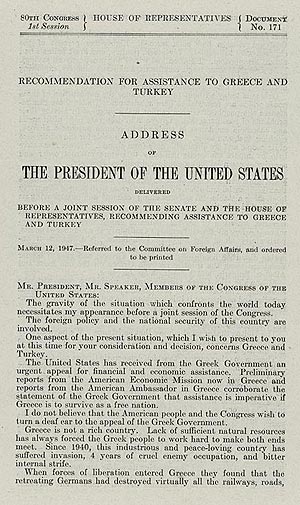
- In the 1930s, America kept out of Europe’s business. But, Truman told Americans that it was their DUTY to interfere. His policy towards the Soviet Union was one of 'containment'– he didn't attempt to destroy the USSR, but he didn't want it to expand.
Marshall Plan:
- George Marshall feared that communism was beginning to become so widely spread that soon every country in Europe would soon be communist. He thought that America should give money to poor countries in Europe to prevent the spread of communism.
Division of Germany:
At the end of World War 2, Germany was divided into four zones. The American, British, and French, zones were grouped together as West Germany, and the Soviet Union Zone became East Germany. West Germany had democratic views and they were against communism therefore they were democrats. On the other hand, East Germany became communistic. West Germany became so successful in terms of growth. They economy grew rapidly. The Soviets preferred factory equipment and other valuable assets from their zone and shipped them back to the Soviet Union. Unfortunately, the economy wasn’t as prosperous because the equipment was sent back to the Soviet Union and the people had severely restricted freedoms.
Berliin Airlift:
West Berlin was a free place, but the soviets in East berlin contined to try to expand to west berlin. Eventually, they blocked part of West Berlin so that the U.S, French, and british couldn't get into West Berlin. Therefore, they shipped more than 2.3 million tons of supplies into West Berlin. West powers even discovered a new currency in atttempts to restart their economy due to the struggle.
Berlin Wall:
Many people didn’t like the living conditions of East Germany and decided to move to West Germany. Losing 2.5 million people and desperately needing people to stay, the Berlin wall was build to stop people from getting to West Berlin.
Hungary 1956:
The Hungarian people were tired of being under Russian government, but were too afraid to stand up and speak out because Stalin punished anyone who spoke against him. Russians had too much power and they showed this by placing thousands of Russian troops and tanks into Hungary. Once Stalin died and the new leader, Khrushchev, came into office and removed the Stalin-appointed rokasi. This gave the Hungarians hope and they decided to protest. They only wanted their sixteen points to a better life, and they displayed rebellion by ruining Stalin’s statue in Budapest, capital of Hungary. Imir Nagy, prime minister, broadcast that Hungary would withdraw itself from the Warsaw pact. Soviets bring in tanks to threaten those who were still willing to protest, and they killed over 30,000 people. Americans were suppose to help the hungarians, but all they did was simply give them moral support and sympathy.
Cuban Missile Crisis:
John Kennedy faced a lot of problems with the foreign missile crisis. This is the closest that the world has been at nuclear war.
USA interests were agricultural.
Fragelico Bastida- non-communist, bad guy that was overthrown by the revolution in Cuba.
Fidel Castro takes over
The Bay of Pigs: CIA plans/ trains Cuban exiles. The invasion starts against Castro. This leads Castro to turn to the USSR for defense (Nuclear missiles were sent to Cuba).
The U-2 spied on this site and confirmed that it actually did happen.
This was a disaster to 1200 people, on April 17t, 1961.
Kennedy said no to supporting the invasion w/ Military.
US OPTIONS:
1) Do nothing
2) Diplomat
3) Go to the United Nations for help
4) Blockade- makes sure nothing comes in or out of Cuba.
5) Surgical Air Strike
6) Invade Cuba
USSR- Mistakes in Turkey, Hard Line Pressure, Premier Nikita Khrushchev.
US/ Soviet Agreement:
- Missiles taken out of Cuba, USSR promises no offensive weapons in Cuba, USA promises not to include Cuba.
End Results:
1) A high point in the Cold War
2) Leads to the end of Khrushchev’s rule
3) Changes Kennedy
4) Changes the Nuclear policy
Czechoslovakia 1968:
In August of 1968, the soviet troops invaded czechoslovakia and it was filled with tanks and troops from warsaw-pact places.The soviets expected the czechoslovakians to fight back and violently protest against the troops and soviet government. Instead, they protested in a non violent matter. They did things such as made annoying noises like rang church bells, blew horns and sounded sirens. They did many other things that also may have indirectly endangered the soviet soldiers like polluted their water or denied them food and many soldiers got sick.
Poland-Solidarity:
-
This was "the labor union strike".
-
The strike that began Polands journy to independence started on the 14th of August 1980.
-
The strike began when 17000 workers went on strike at the Lenin Shipyard in Poland.
-
17 days later after attempting to negotiate with the communist government, the workers were granted their own independent trade union.
-
The government gave in to many of the workers demands granting them the right to organise and strike.
-
As time went on, the union grew Poland's Soviet overlords grew uneasy and they outlawed solidarity. In June 1989 after pressure from foreign governments and round table negotiations Poland held its first free elections, the first free elections in the Soviet blocade.
Cultural Revolution:
- The cultural revolution of the cold war was significant.
- The goal of this revolution was to try and make sure that China did not end up like Soviet Russia.
- Chinese Communist Party (CCP) chairman, Mao Zedong quotes the revolution to be: "A great revolution that touches the people to their very souls." Mao wanted the Chinese government to drift from socialism and toward capitalism to avoid the Soviet's fate.
- The cultural Revolution ended in October of 1976.
- It ended a month after Mao ZeDong died.
- When the Govt. of China arrested the "gang of four" which included four leaders of the revolution many revolutionaries laid down their weapons. 1966-1976 is refered to in China as the "decade of chaos".
Red Guards:
- The Red guards were a group of children sent by the government to destroy and capture anyone without communist beliefs. They were forced to participate in these acts as they were helping Mao and doing their duty as good communist. Few were actually forced, because many of the children voluntarily committed these acts because they felt like they were in power.
Great Leap Forward
Mao wanted to boost china’s economy by modernizing Chinese society. Mao created a plan to develop farming and manufacturing in China. This plan was known as the ‘Great Leap Forward’. China was transformed into a communist country in order for this plan to appropriately take place.
The Cultural Revolution of China: THE OLD IS BAD
· In 1949- China becomes Communist.
· There were two categories in the China communist subcategories:
· 1) Fire Red Categories (good people). The workers, soldiers, peasants, marters, cadres (good communist's)- They together put together the Red Guard.
· 2) The Five Black Categories: The Ladlords, The rightests, capitalist roaders, counter revolutionaries and Rich Peasants.
· In 1976 Mao dies- the whole civilization of China now is unsure what to do because Mao made such a big influence of their ways of living.
· Shortly after, Dong Shao Ping takes over.
· Dong Shao Ping opens up relations with Chinese economy. He makes China an economic power, he allows for a profit motive to occur.
